When people start planning a new kitchen, they usually ask the same questions.
‘Should I choose quartz or granite?’
‘Which colour works best?’
‘How much will it cost?’
They’re all sensible questions but they aren’t necessarily the only ones.
After more than 20 years of fabricating and installing worktops, we’ve found that the questions homeowners don’t ask are often the ones that have the biggest impact on the finished kitchen.
Here are a few questions we think every homeowner should ask before choosing their stone worktops.
Who Is Actually Fabricating My Worktops?
This might sound obvious but it isn’t always clear.
Some companies have their own workshop and install everything themselves. Other outsource fabrication or installation to third parties.
Neither approach is automatically right or wrong, but it’s worth understand who will actually measure, manufacture and install your worktop.
When one experience team manages the entire process, communication is simpler and responsibilities are clearer.
Can I Actually View A Slab?
Many people choose stone from a small sample.
While samples are useful, they rarely show:
- Large veins
- Colour movement
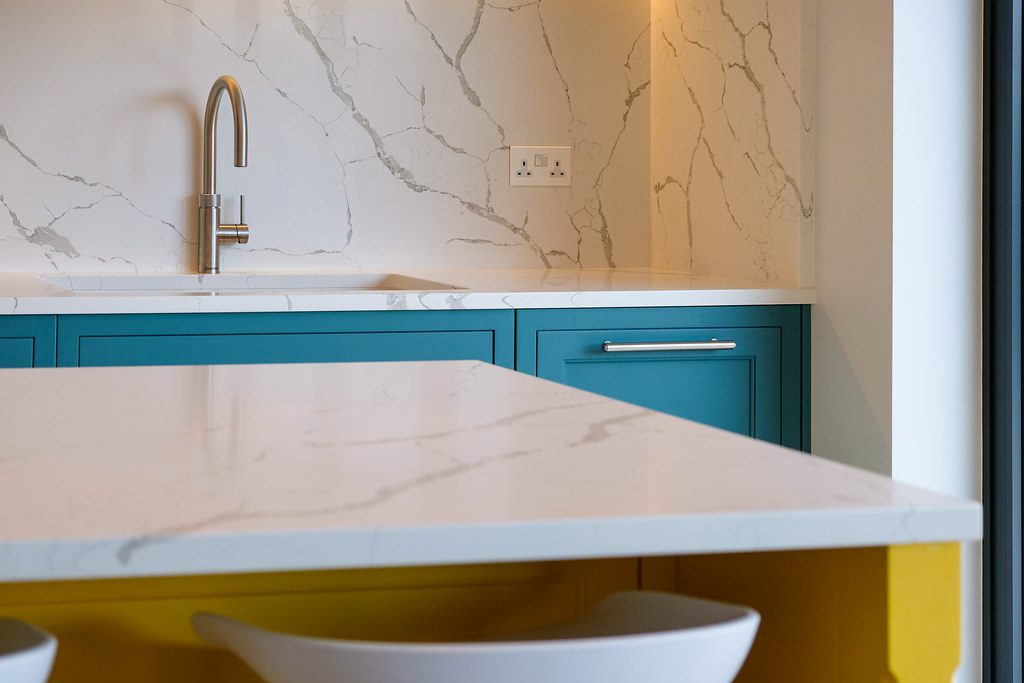
- Natural variation
- Book-matching opportunities
Viewing the full slab gives you a much better understanding of how the finished worktops will look.
It also allows you to discuss where key feature of the stone might appear on the island or worktops.
It is worth noting that this is less relevant for quartz, which has consistency but with natural stones it’s an absolute must to see the stone in person.
Who Decides Where the Veining Goes?
This is one of the questions that almost nobody asks. Yet it can completely change the appearance of a kitchen.
The orientation of veining can affect:
- Islands
- Waterfall ends
- Splashbacks
- Corner joins
A well planned layout makes the stone feel intentional rather than random.
A good stonemason will automatically know the best way to cut the stone to maximise the veining however, there may restrictions based on the slab size and what it needed from it. Your fabricator should work with you to accommodate any specific requests wherever possible.
Where Will the Joins Be?
Every stone slab has physical size limitations.
This means the kitchen may require one or more joins.
Rather than asking ‘Will there be any joins?’, ask:
‘Where will they be, and why?’
An experienced fabricator will position joins where they are least noticeable while maintaining the structural integrity of the worktop.
What Happens If My Walls Aren’t Straight?
Here’s a secret……..
Very few walls are perfectly straight.
Older properties, extensions and even new-build homes can all have small variations.
This is why accurate templating is so important.
Professional templating allows for worktops to follow the room rather than assuming every wall is perfectly square.
Is This the Right Stone For How We Actually Live?
The most beautiful stone isn’t always the best choice.
Think about your household.
Do you have young children?
Do you entertain regularly?
Would you prefer something that requires very little maintenance?
The best worktop isn’t simply the one that you admire in the workshop, it’s the one that suits your lifestyle.
What Happens After Templating?
Your fabricator has taken measurement, what happens after this?
Typically, the process includes:
- Final checks
- CAD drawings
- Fabrication
- Edge polishing
- Sink and hob cut-outs
- Quality inspection
- Installation
Understanding the journey helps remove uncertainty and gives you confidence in the process.
What Is Including in the Quote?
Not all quotations include exactly the same things?
Before comparing prices, ask whether the quotation includes:
- Templating
- Delivery
- Installation
- Sink cut-outs
- Hob cut-outs
- Upstands
- Splashbacks
- Edge profiles
Two quotes may look similar but represent very different levels of service.
Can This Material Be Repaired If It’s Damaged?
Accidents are rare, but they do happen.
Understanding how different materials can be maintained or repaired helps you make a more informed long-term decision.
It’s another question many homeowners only think about after installation.
Will I Still Love This Stone in Ten Years?
Not one for your fabricator but it is the most important questions to ask yourself.
Kitchen trends come and go but you will probably have your worktop for a lot longer.
Rather than looking at what’s fashionable today, think about what will still feel practical, comfortable and beautiful for many years to come.
Timeless materials, careful planning and quality craftsmanship almost always outlast short-lived trends.
The Best Questions Lead To Better Outcomes
Choosing stone worktops is about far more than selecting a colour.
The conversations you have before fabrication begins often determine how satisfied you’ll be long after the kitchen is finished.
We encourage customers to ask questions – lots of them.
Because the more informed you are, the more confident you’ll feel in the decision you make.
And in our experience, the best kitchens don’t happen by chance, they happen through good planning, honest advice and skilled craftsmanship.
Stone worktops are a significant investment, and asking the right questions can make all the difference. By understanding how your worktops will be measured, fabricated and installed you are far more likely to end up with a kitchen you’ll enjoy for many years to come.
If you are planning a new kitchen and would like to talk through your options, visit our showroom in Bicester. We’d be delighted to answer any questions you have already thought of and probably some that you haven’t.